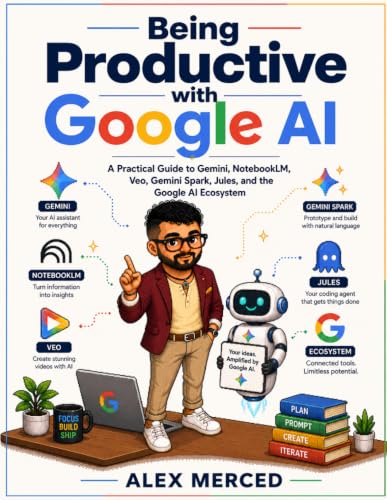
Being Productive with Google AI
Published by Self-published · Tech
A practical guide to using Google's AI ecosystem including Gemini, NotebookLM, Veo, Gemini Spark, and Jules.
Who this book is for
Written for Google Workspace power users, researchers and knowledge managers, developers adding Google AI to their stack, and content creators who want to turn Gemini, NotebookLM, and related tools into a real daily workflow.
Table of contents
- Google AI in 2026
- Gemini Chat: The Foundation Surface
- Prompting Gemini Effectively
- NotebookLM: Research at Scale
- Audio Overviews and Shareable Research
- Gemini in Google Workspace
- Gemini Live: Real-Time Multimodal Interaction
- Veo and Video Generation
- Gemini Spark: Your Autonomous Background Agent
- Jules: Asynchronous AI Coding Agent
- Google AI Studio and the Gemini API
- Building Your Google AI Workflow
Excerpt
Every morning before I start writing, I open NotebookLM. I have a notebook with 40-something sources in it: research papers, product documentation pages, previous chapters I have written, interview transcripts, blog posts I saved months ago and never got around to reading properly. Before I sit down to write anything substantial, I ask NotebookLM a question about whatever I am working on that day. Sometimes the question is broad: "What are the most important points I have not addressed yet in my sources on this topic?" Sometimes it is narrow: "Which of my sources mentions the context window size constraint in a way that I could cite directly?" The answers take about two seconds.