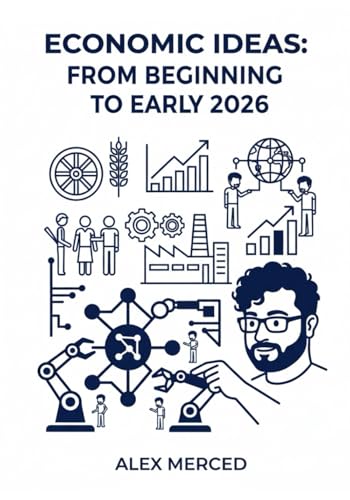
Economic Ideas: From Beginning to Early 2026
Published by Self-published · Economics & Philosophy
A survey of the history of economic thought, tracing ideas from ancient civilizations through the modern AI era.
Who this book is for
General readers curious about economics, history, or political theory, including students, professionals, policymakers, and self-taught learners. No economics degree, equations, or prerequisites are needed.
Table of contents
- Before Economics: Trade, Barter, and the First Questions About Value
- Greek Foundations: Xenophon, Plato, and Aristotle on Wealth and the Good Life
- Rome, Roads, and the Price of Empire
- Medieval Economics: Just Price, Usury, and the Scholastics
- The Islamic Golden Age: Ibn Khaldun and the Economics of Civilization
- Mercantilism: Gold, Trade Wars, and the Birth of Economic Policy
- Richard Cantillon: The Secret Father of Economics
- The Physiocrats: Nature's Economists
- Adam Smith: The Invisible Hand and the Wealth of Nations
- David Ricardo: Comparative Advantage and the Logic of Trade
- Thomas Malthus: Population, Poverty, and the Dismal Science
- John Stuart Mill: The Liberal Reformer
- Karl Marx: Capital, Exploitation, and Revolution
- The Marginalist Revolution: Value Is in the Eye of the Buyer
- The Methodenstreit: How Should We Do Economics?
- Henry George: Progress, Poverty, and the Tax on Land
- The American Institutionalists: Economics Gets Real
- The Gold Standard: Monetary Orthodoxy and Its Discontents
- The Austrian School: Mises, Hayek, and the Socialist Calculation Debate
- John Maynard Keynes: The General Theory and the End of Laissez-Faire
- The Keynesian Consensus and the Postwar Boom
- The Chicago School: Milton Friedman and the Monetarist Counterrevolution
- Development Economics: Why Are Some Countries Rich and Others Poor?
- Public Choice Theory: When Government Fails
- Game Theory: Strategy, Conflict, and Cooperation
- Rational Expectations and the New Classical Revolution
- Supply-Side Economics: Tax Cuts and the Laffer Curve
- The Fall of Communism and Transition Economics
- Behavioral Economics: When People Are Not Rational
- Information Economics: When Markets Know Too Little
Excerpt
Economics is among the oldest and most contested fields of human inquiry. For as long as people have lived in societies, they have debated how to allocate scarce resources, organize production, distribute wealth, and design the institutional rules that govern exchange. These debates are not merely academic. They shape the policies that determine whether nations prosper or stagnate, whether individuals enjoy material comfort or endure deprivation, and whether democratic societies hold together or fracture under the weight of inequality and distrust. This book tells the story of those debates from the very beginning to the early months of 2026.