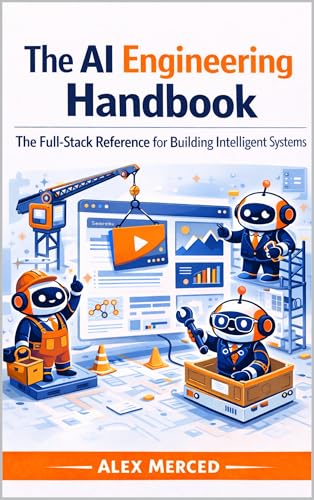
The AI Engineering Handbook
Published by Self-published · Tech
A full-stack reference for building AI systems, covering LLMs, embeddings, agents, RAG, and production deployment patterns.
Who this book is for
AI engineers at any level who want a single reference, software engineers moving into AI engineering, full-stack developers adding AI features to applications, and technical leaders who need to understand the whole AI engineering stack.
Table of contents
- AI Engineering as a Discipline
- Foundation Models
- Prompting and Context Engineering
- Embeddings and Retrieval
- Retrieval-Augmented Generation
- Knowledge Graphs and Structured Knowledge
- Agent Architectures
- Memory Systems
- Multimodal AI
- Evaluation and Testing
- Production AI Systems
- Data for AI
- Safety, Ethics, and Governance
- The AI Engineer's Toolkit
Excerpt
Ideal characteristics. High value and low risk: internal-facing (not customer-facing), well-defined success criteria, domain experts available for evaluation, and existing data that can power the feature. Customer support automation, internal knowledge search, and document summarization are common first projects. Avoid these as first projects. Customer-facing chatbots (too visible if quality is low), autonomous decision-making (too risky without experience), and projects requiring custom model training (too complex for a first effort).